Wednesday, March 5, 2014

(LUKE) Thoughts on a new baby

In October 1923, Jennie Constance Adamson married Rudolph Edwin Lang. A few months later, her brother, George, departed for a two-year LDS mission to England. George and Jennie exchanged letters while he was gone. Perhaps the most interesting letter George wrote, penned in September 1924, was in response to a letter informing him that he was now an uncle.


"So I am an uncle eh! Well I could be worse things. Congratulations and my love to both of you and the baby. From what I can gather from your letter and mother's, it certainly must be a very fine, wonderful and pretty baby. If it looks anything at all like its uncle George it certainly is a good looking child. ... I'll bet you that it isn't one-half as fine as I will have when I get married? Of course it must be a fine baby, but then a man with a wonderful Physical body such as mine is bound to have better children than a man with a constitution such as Rudolph's. Now my wife will be better looking than Jen. ...
"All foolishness aside I think that it must be a very fine baby and I only wish that I could be there to see it. If you are ever in doubt as to how to fetch it up why just ask me and I will tell you. The care of babies is just my line."

Although it is doubtful that Jennie asked her 20-year-old bachelor brother for parenting advice, she must have enjoyed his letter, which was written in his usual humorous tone. And she certainly enjoyed her new baby: Zenda Constance Lang.

Zenda Lang, 1924

Sunday, March 2, 2014

(SCOFIELD) Thomas & Elizabeth Bennett family migration

Since its beginnings, the Church of Jesus Christ of Latter-day Saints has been a missionary church. In the 19th century, tens of thousands were converted in the British Isles.

Thomas Bennett’s family were among the first Welsh converts.1 Thomas married Elizabeth Williams in 18752 and they began raising their family in Newcastle, England.3 But they did not stay long. It was a time of gathering. “During the 19th century, ‘gathering’ to Zion was the second step after conversion. … The gathering had two major purposes. First, Zion needed to be built up. Repeatedly persecuted and driven, the Church needed a strong, permanent base with a strong population to occupy the territory [of Utah] and make it economically self-sufficient. Also, the pure in heart needed a place of refuge from persecution and sin.”4 A fundamental part of the spiritual refuge was temple access. At that time, there were temples only in Utah.5 Persecution certainly did not end in Utah, but it was probably easier to bear when one could draw strength from the surrounding group of believers.

Like many others, the Bennett family emigrated somewhat piecemeal. Elizabeth and five of the children departed together. Thomas followed shortly thereafter, and the oldest daughter, Sarah, apparently traveled a few months later. This story follows Elizabeth, but her husband’s and daughter’s passages would have been quite similar.

Elizabeth and the children left Liverpool on Saturday, June 14, 1884. They traveled with 525 other Latter-day Saints: 406 from Scandinavia, 94 others from Great Britain, and 25 returning missionaries.6 

The SS Arizona, from norwayheritage.com
They sailed on the SS Arizona. “The Arizona was a record breaking British passenger liner.” The ship took about 8 days to reach New York from Liverpool, rather than 10. “One nautical historian called Arizona ‘a souped up transatlantic hot rod.’” The Arizona began sailing in 1879. That same year, she hit an iceberg and sustained heavy damages. However, she underwent repairs and continued sailing until 1897. The steamliner was then purchased by the US Navy, renamed Hancock, and used in the Spanish American War and World War I.7

“After a pleasant and speedy voyage the mighty vessel arrived in New York on Monday, June 23rd, and the same day the passengers landed at Castle Garden.”8 
Me at Battery Park/Castle Garden, October 2012.
The Statue of Liberty (slightly visible in background)
was placed a few years after the Bennetts' arrival.

Around 1808, due to “increasing tensions with the British, American harbor cities began building forts for protection.” New York City built four: one, named Southwest Battery, was on Manhattan Island. Southwest Battery was fortified during the War of 1812, though it never saw action. In the 1820s, the site was given new life as an entertainment center/opera house and was renamed Castle Garden. In 1855, the facility became the nation’s first “immigrant landing depot," giving newcomers like Elizabeth Bennett a safe place to rest and make further travel plans. After Ellis Island opened in 1890, Castle Garden was converted to an aquarium. Today, it is a national monument.9

Castle Garden was well organized.  Upon disembarking, people moved through
“Mormon Emigrants Landing on the Wharf at Castle Garden
from Ocean Steamers,” 1878 
15
“a narrow passageway” while “being subjected to medical inspection. …When the inspection was completed, the emigrants were herded into Castle Garden proper and marched up to a square enclosure in the center [to be registered]. Barriers were installed on each side to ensure that all were registered….Each emigrant moved along the alley, stopped before the registering clerks, and then proceeded on.” Castle Garden contained “two washrooms, each fifty by twenty in size. … An abundance of towels was conveniently hung about, and soap was not only handy but also required to be used. Every emigrant landing at Castle Garden was washed clean before he or she was permitted to leave.”
10

Castle Clinton National Monument, formerly known as Castle Garden.
I took this picture in October 2012.

Clerks inside Castle Garden helped emigrants plan the rest of their US travel, whether by boat or train. Latter-day Saints, however, had their own emigration agents who purchased tickets for them. “Mormons avoided much of the stress suffered by their countrymen who passed through the Garden. The majority of Latter-day Saints [including the Bennetts] were escorted by leaders who were Americans by birth or had previously emigrated to the United States. … They were also schooled ahead of time on the latest news that had arrived from America and were given detailed letters of instruction….Normally [as was the case for this voyage], a Mormon agent received the emigrants and walked them through the registration process.”10

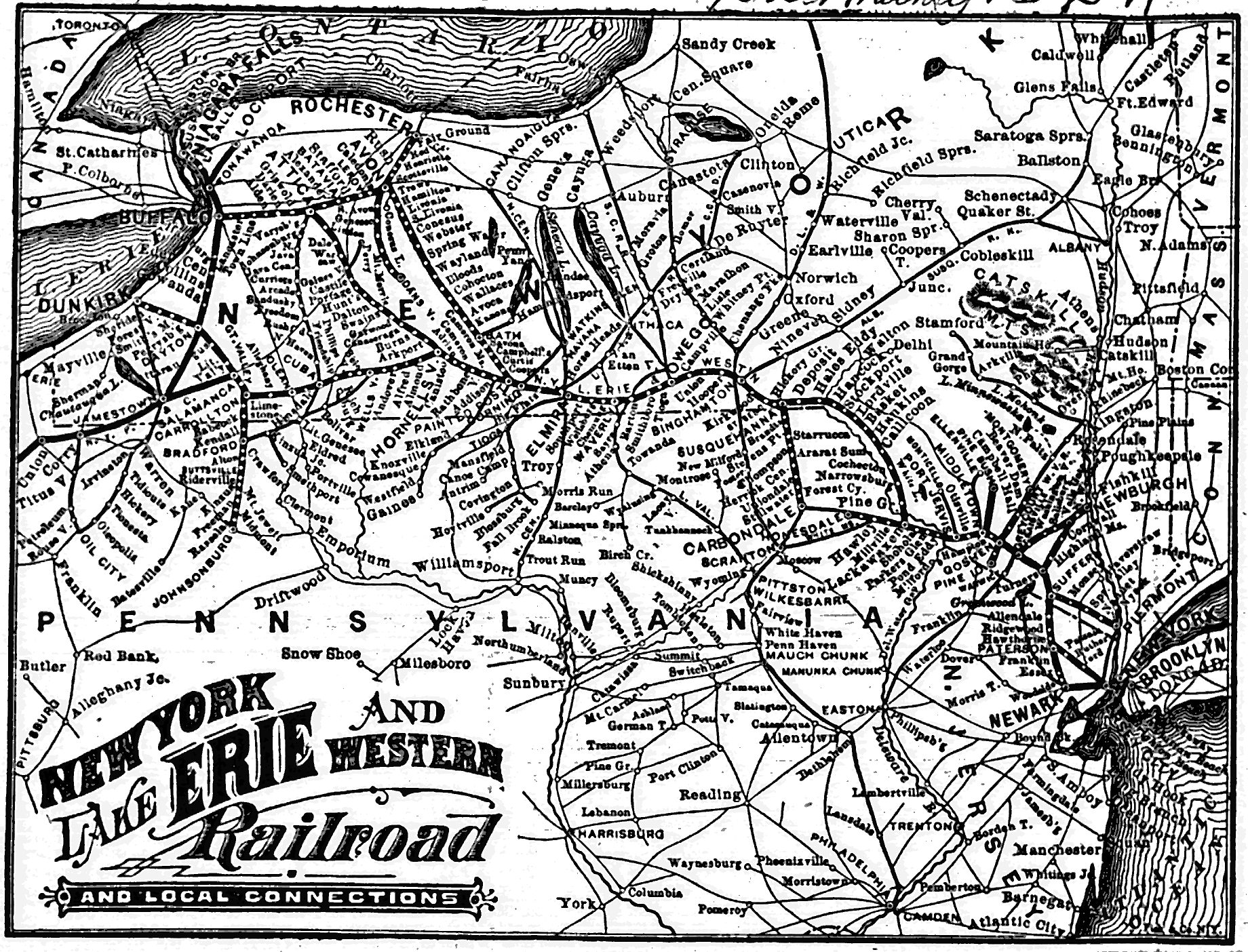
On the evening of their arrival (Monday, June 23), the emigrants left Castle Garden, New York, for Jersey City, New Jersey. From Jersey City, the emigrants traveled in 11 cars on the Erie Railroad. At Salamanca, New York, they switched to the Chicago & Atlantic Railroad. 

This 1884 map of the Erie Railroad lines shows the extent of Elizabeth Bennett's travel on that line -
from Jersey City to Salamanca. The location of Susquehanna is also noted.16


This depiction is from an 1882 album of views along the Erie RR. Passing through this area might have had some significance for Elizabeth, as the first baptisms in this dispensation occurred in the Susquehanna River.17
They reached Chicago, Illinois at 8:30pm on Wednesday, June 25. The immigrants were given two additional railroad cars and transferred to the Chicago & Western Railroad. They departed Chicago at 12:30am, headed for Council Bluffs, Iowa.

The party reached Council Bluffs at 11pm. They transferred to the Union Pacific Railroad, and were also transferred into different railroad cars.  For Elizabeth Bennett, traveling with 5 children under the age of 5, all these late-night transfers must have been difficult.

Ogden, Utah, 1875, from www.history-map.com

On the morning of Sunday, June 29, the train reached Ogden, Utah, the Bennetts’ final destination. We don’t know Elizabeth’s first impression of her new home, but her thoughts about the train depot might not have been favorable. At that time, “the local press was filled with complaints about the dark and gloomy depot, with its quarter-mile of wooden sidewalks across swampy mud flats…that served as the embarrassing entrance to Ogden. The complaints included calls for the carriers to erect permanent buildings and workshops, and to 'go to work like substantial corporations, instead of dickering around in shanties.'”11  

In just 14 days, Elizabeth and her five small children traveled about 5,500 miles across the globe. They joined a substantial group of immigrants: at that time, about 30% of Utahns were foreign-born. 

Americans had differing opinions on the value of immigration. “An 1881 Harper’s article denounced the Church for consisting of ‘foreigners and the children of foreigners …fresh serf blood from abroad.’”12  Some were more positive. Another article stated, "by the work and activities of the emigrants many barren regions have been turned into fertile and civilized nations. The New World and particularly the United States has profited from the European migration.”13 


Like other LDS immigrants, the Bennetts probably thought of Isaiah as they transformed the barren Great Basin: “The wilderness and the solitary place shall be glad for them; and the desert shall rejoice, and blossom as the rose.”14 


_____________________________________________________________
Line of descent: 
Thomas Edward Bennett (1854 - 1935)
Sarah Ann Bennett (1876 - 1942)
Clara Lavon Cheshire (1915 - 2007)


Notes:

This entire post, and especially the section dealing with railroad travel, relies heavily on from 4 accounts of this voyage available at http://mormonmigration.lib.byu.edu/Search/showDetails/db:MM_MII/t:voyage/id:40/keywords:thomas+bennett

1 – Obituary, Salt Lake Telegram, 27 Nov 1935, http://udn.lib.utah.edu/cdm/compoundobject/collection/tgm18/id/74959/show/75315/rec/45

2 – https://familysearch.org/tree/#view=coupleRelationship&relationshipId=MZ8N-2WT Relationship information about Thomas and Elizabeth, accessed 2 March 2014.

3 – Newcastle is the Conference listed on their passenger lists: http://mormonmigration.lib.byu.edu/Search/showDetails/db:MM_MII/t:voyage/id:40/keywords:thomas+bennett  and http://mormonmigration.lib.byu.edu/Search/showDetails/db:MM_MII/t:voyage/id:37/keywords:thomas+bennett, and see Thomas’s obituary, cited in footnote 1

4 – “Coming to Zion: Saga of the Gathering,” William G. Hartley, Ensign, Jul 1975, https://www.lds.org/ensign/1975/07/coming-to-zion-saga-of-the-gathering?lang=eng 

5 – http://www.ldschurchtemples.com/chronological/

6 – see http://mormonmigration.lib.byu.edu/Search/showDetails/db:MM_MII/t:voyage/id:40/keywords:thomas+bennett 

7 – http://en.wikipedia.org/wiki/SS_Arizona

8 – “A Compilation of General Voyage Notes, Liverpool to New York on the Arizona (14 Jun 1884 - 23 Jun 1884)” http://mormonmigration.lib.byu.edu/Search/showDetails/db:MM_MII/t:account/id:88/keywords:thomas+bennett

9 –National Park Service website, Castle Clinton National Monument, History & Culture, http://www.nps.gov/cacl/historyculture/index.htm, accessed 2/24/2014

10 – “Castle Garden, the Emigrant Receiving Station in New York Harbor,” Don H. Smith, http://mormonhistoricsites.org/wp-content/uploads/2013/05/NJ10.1_Smith.pdf, quotes are from pages 4-9

11 – “Ogden Union Railway & Depot Company,” http://utahrails.net/ogden/ogden-ourd.php

12 – “Coming to Zion: Saga of the Gathering,” William G. Hartley, Ensign, Jul 1975, https://www.lds.org/ensign/1975/07/coming-to-zion-saga-of-the-gathering?lang=eng

13 – “Castle Garden As An Immigrant Depot 1855-1890”, Dr. George J. Svejda, 1968 http://www.nps.gov/history/history/online_books/elis/castle_garden.pdf p. 2

14 – Isaiah 35:1, https://www.lds.org/scriptures/ot/isa/35.1?lang=eng#primary

15 - Picture from http://www.mhsarchive.org/FullImages/CACL00249-03239-jpg635004195780000000.jpg

16 - Map from article at http://en.wikipedia.org/wiki/Erie_Railroad article, map alone at http://upload.wikimedia.org/wikipedia/commons/e/e9/1884_Erie.gif

17 - Picture from http://www.erierailroad.org/web_documents/erie-railway-album_1882.pdf


Monday, February 17, 2014

(ROBERTS) My first slave-owners! (Although I use the term "owners" loosely)

After 13 years of family history research, I have finally found some ancestors who owned slaves. I have long been proud of my Northern roots and my family's lack of involvement in slavery. And, after discovering this couple, I am still proud.
Rev. Simon Peter

Simon Peter married Elizabeth Hannah Hughes in 1822. They were both born and raised in "slave states": he in Kentucky, she in Tennessee. Simon was a minister for the Methodist Episcopal Church. After their marriage, he preached in the area for six additional years, at which point the couple "removed..., with a view of locating somewhere on the free soil of Illinois."1 According to one source, Simon left the South "because of his bitter opposition to slavery"2.

And so we come to the slave "ownership." A book documenting prominent Tennessee families includes this comment:  “Elizabeth Hughes, who married Rev. Simon Peter... removed to Illinois, carrying with them several valuable slaves and emancipating them because they were convinced the institution of slavery was wrong. It need not be added that the courage to do right under such
Elizabeth Hannah Hughes Peter
temptations sustained them in a life of usefulness and great prosperity.”
3

Elizabeth's third cousin was also opposed to slavery, famously so. In 1864 he wrote, "If slavery is not wrong, nothing is wrong."4 Shortly thereafter, he worked with Congress to pass the 13th Amendment, abolishing slavery. His name? Abraham Lincoln.5 [Incidentally, we are also distant cousins of Mitt Romney through the same line.] 

Simon and Elizabeth had closer relatives also involved in the Civil War. Two of their sons "yielded to the voice of conscience, and their country's call"6 and served on the Union side. Both gave their lives fighting for the country they loved, and for the freedom of millions. Sadly, one died in battle in his mother's own home state--Tennessee.

In every article I have read, Simon, Elizabeth, and their children, are praised for their uprightness, their community service, and their devotion to doing right. They are among my noblest ancestors, and I am proud to be descended from Simon and Elizabeth Peter.


________________________________________________________
Line of descent:
Simon Peter (1792-1877) [my 4th-great grandfather]
Simon J Peter (1836-1923)
William H Peter (1868-1923)
Earl Raymond Peter(s) (1893-1963)
Dolores Mae Peters Roberts (1927-1992)

Notes:
1) "The Story of the Peter Family in America," compiled by Stephen B. Peter, p. 21, Carlinville obituary. Available from the Family History Library as a PDF download, see https://familysearch.org/search/catalog/oclc/866000813?availability=Family%20History%20Library [Hereafter cited as "Peter Family"]
2) "Peter Family", p. 23, quoting "There the Heart Is, A History of Brighton, Illinois," by Martha A. Bentley, 1965, p. 53
3) Sketches of Prominent Tennesseans: Containing Biographies and Records of Many of the Families who Have Attained Prominence in Tennessee (Google eBook), p. 231 [I am well aware that this implies that Elizabeth's parents owned slaves, and I still love them and think they're wonderful. I certainly don't have any living relatives who are perfect, so I don't expect that from the dead ones either. :) ]
4) http://www.abrahamlincolnonline.org/lincoln/speeches/hodges.htm
5) This chart, showing the relationship between Elizabeth Hughes Peter and Abraham Lincoln is from "Peter Family," p. 27

6) "Peter Family," p. 44, "Letter to the Editor"


Sunday, January 19, 2014

(SMITH) From having maids to living in poverty--leaving it all for the gospel

Peter Zemp was born in Escholzmatt, Switzerland, a breathtakingly beautiful hill-and-valley area that is now part of the UNESCO Entlebuch Biosphere Reserve.1

Peter Zemp was born in this farmhouse, called "Ruetihus," according to
contributors at familysearch.org.2 

Peter Zemp was born in the middle house, obscured by the trees in this 2008 photo.2
As a boy, Peter moved to La Chaux-de-Fonds, a Swiss city close to the French border. Peter and his family were watchmakers. To this day, the prosperity of La Choux-de-Fonds "is mainly bound up with the watch making industry. It is the most important centre of the watch making industry in the area known as the Watch Valley."3 La Chaux-de-Fonds is also a beautiful place, and is now a UNESCO World Heritage site.3

La Chaux-de-Fonds, from opentravel.com4
As watchmakers, Peter and his wife, Elisabeth Neuhaus Zemp, were somewhat well-to-do. They apparently owned their own business and employed four girls. They also had at least one housemaid, and Elisabeth did no housework for years. Elisabeth "had maids to tend the children and...even comb her hair."5

On January 1, 1879, Peter and Elisabeth Zemp were baptized into the Church of Jesus Christ of Latter-day Saints.6 They decided to emigrate to Utah. They were disowned by family and sold their business at a loss.5

The Peter and Elizabeth Zemp after emigration. Pictured with
their children Pierce, Alfred, and Amelia.2
"[I]n Utah, [Peter] could not make his living as a watch maker, as the people were poor.  He met with one disappointment after another.  He settled first in Salt Lake, then in Logan.  He would do any kind of work he could get."5

Eventually, things improved for the family. Peter became a foreman for a railroad company, built his own house, and again established himself as a watchmaker.5
Peter Zemp's home in Logan, Utah, which is no longer standing 7
"Peter was very religious....The gospel was his all."5 Being able to see his children grow up with the blessings of the gospel probably far outweighed any material sacrifices he had made. He seems to have lived by the command: "thou shalt lay aside the things of this world, and seek for the things of a better."8

Peter's obituary verifies that he understood the things that matter most: "He was honest, industrious and true to his friends and his convictions, and will certainly receive the plaudits of the Master when he shall meet Him on the other side, for being a man of deeds rather than words"9.

_________________________________________________________________
***This post relies almost completely on research done by others. I have NOT verified the accuracy of the genealogy or the facts of Peter's life, but I do believe them to be correct.


Line of descent:
Alice Zemp, 1925-2000
William Zemp, 1886-1942
Peter Zemp, 1837-1909


Sources:
2: Photos taken from familysearch.org/tree on Peter Zemp's page. Peter Zemp's identifier is KW81-66K. This is a link to the first picture: https://familysearch.org/photos/images/2654441?returnLabel=Peter%20Zemp%20(twin)%20(KW81-66K)&returnUrl=https%3A%2F%2Ffamilysearch.org%2Ftree%2F%23view%3Dancestor%26person%3DKW81-66K%26section%3Dphotos
5: These paragraphs rely on two sources, "Life of Peter Zemp" and "Part of a letter written by Aunt Emily - May 14, 1942," available on Peter Zemp's familysearch.org page: https://familysearch.org/tree/#view=ancestor&person=KW81-66K&section=stories
6: According to the Ordinances section on his familysearch.org page, https://familysearch.org/tree/#view=ancestor&person=KW81-66K&section=details (and the same section on her page)
8: Doctrine and Covenants 25:10
9: Obituary under "Death of Peter Zemp in newspaper" at https://familysearch.org/tree/#view=ancestor&person=KW81-66K&section=stories


Sunday, November 24, 2013

(SCOFIELD) Robert Wixam and “The White Man’s Fly”


*NOTE: First, the genealogy to this person is at the bottom of the blog. If you are wondering how you’re related, that’s the place to check. Second, sources are also listed at the bottom. Third, I have not verified the line of genealogical descent; I am relying on the accuracy of other contributors to familysearch.org.*


Robert Wixam supposedly came to Massachusetts in 1630 as part of the “Winthrop Fleet.” This group of about a dozen ships was led by John Winthrop, who became the governor of the Massachusetts Bay Colony. Many of the passengers were Puritans.

Plymouth Colony map.png
From http://familysearch.org/learn/wiki/en/Plymouth_Colony

Robert and his wife, Alice, settled in Eastham (on the Cape Cod peninsula), Barnstable County, Massachusetts. On October 1, 1686, Robert wrote his will. In this last testament, Robert specifically mentioned land, housing, cows, and… a beehive.

“Robert Wixam of Eastham being very weak and infirm of Body but yet in perfit memory and understanding and not knowing the time of my departure but dayly expecting when my chang shall be, Leave this as my last will and testament…

“I do give up to daughter Jemimah one Browne Cowe with a Starr in the fore head and one hive of Beese, and house room and priviledg in the orchard as long as shee lives unmaried….

“This I leave as my last will and testament with Liberty to add to or Alter as I may see cause If God shall be pleased to prolong my days.”1

Robert’s days were not prolonged: in less than a fortnight, his bequests were granted.

After his death, his belongings were inventoried. [I have copied a transcription of the inventory to the bottom of this post.] Among the miscellanea were a pot hanger, wooden trenchers, fire tongs, pewter, brass, gunpowder, Indian corn, rye, oxen, calves, and two beehives. The beehives together were valued at 10 shillings—the same price as a bedstead, an old horse, a pig, or 4 spinning wheels. Why were the bees worth as much as a horse?

Example of an early beehive, from
http://outdoorplace.org/beekeeping/history1.htm
Honeybees are not native to the United States. They were first imported to Virginia in 1622 and appeared in Eastham about ten years before Robert’s death.2 By this time, honeybees were actually relatively inexpensive, considering that 40 years before, they had cost four times more. Robert bequeathed his hives at a time when honey had become a common food in the colonies.3

The lower prices were largely due to the importation of more hives, and partly due to the fact that bees are not truly domesticated, and “feral” bees began to colonize the continent.4 Some colonists were able to raid honey from wild hives.

In the 1780s Thomas Jefferson wrote of feral bees, “The bees have generally extended themselves into the country, a little in advance of the white settlers. The Indians therefore call them the white man's fly.”5

An American essayist later wrote, “The Indian regarded the honey-bee as an ill-omen. She was the white man’s fly. In fact she was the epitome of the white man himself. She has the white man’s craftiness, his industry, his architectural skill, his neatness and love of system, his foresight; and, above all, his eager, miserly habits. The honey-bee’s great ambition is to be rich, to lay up great stores, to possess the sweet of every flower that blooms. She is more than provident. Enough will not satisfy her; she must have all she can get.”Once bees arrived, settlers were usually not far behind. 

Bees may have their faults, but in the 17th century, when cane sugar was prohibitively expensive, honey was the primary sweetener for the “ordinary man.”2 And it certainly must have been for Robert Wixam and his family.


___________________________________________________
Line of descent:
-      Guy Wixon Scofield, 1913-1984
-      John Wixon Scofield, 1888-1963
-      Florence Amanda Wixson Scofield, 1844-1896
-      John Wixson, 1821-1893
-      Daniel Wixson, 1786-1852
-      Solomon Wixson, 1749-1813
-      Joshua Wixon, 1695-173
-      Barnabus Wixam, 1663-1735
-      Robert Wixam, 1624-1686


Sources:

Other sources:
-      http://www.sneydobone.com/webtree/wixson/wixam.htm - information on Robert Wixam


Below is the inventory taken of Robert’s estate after he died.1 Items are listed followed by their worth.

[1:4] October 11: 1686
An Invintory of the Estate of Robert Wixam of Eastham deaseaced as follows

2 Oxen .................................. 06-10-00
1 Stear .................................. 01-15-00
1 Cow ................................... 01-15-00
3 Cows .................................. 06-00-00
1 Heifer, 1 Steere ................ 02-15-00
3 Calves ................................ 01-01-00
1 old Mare ............................ 00-12-00
1old Horse ............................ 00-10-00
2 Swine ................................. 01-00-00
In Indian Corne ..................... 01-00-00
In wheate ............................... 01-03-00
In Rye ...................................... 01-00-00
In Iron .................................... 00-12-00
2 hives of Bees ....................... 00-10-00
In Pewter.................................. 01-02-00
In Earthen Ware....................... 00-01-08
In Books.................................... 00-07-00
Sheep Steers............................. 00-01-03
Iron Box and heatre.................. 00-02-00
In Brass .................................... 02-00-00
Powder and bullits ................... 00-02-00
One Iron Pott and hooks ......... 01-00-00
One pott hanger........................ 00-01-00
2 Spinning wheels ................... 00-05-00
Wooden trays & trenchers...... 00-08-00
Tobacco ................................... 00-10-00
One Fether bed and bolster, One old rugg and
old blankit...................02-15-00
One old bed & bolster.............. 00-16-00
One Bedstead .......................... 00-10-00
2 old Sives and old bagg........... 00-02-00
One bed and bolster and three pillows and old rugg
& blankit................. 03-10-00
One bedstead & Settile............. 01-00-00
One table and forme ................ 01-00-00
3 chairs ..................................... 00-03-00
1 forme old pails ...................... 00-02-00
1 fire slice and tongs ................ 00-03-00
his wearing clothes .................. 01-06-00
In Linning ................................. 03-04-00
2 Chests and box ........................00-12-00
The Total is ......................... 48-05-11


Sunday, November 17, 2013

(LUKE) Please Come Get Your Carp

“In 1877, the U.S. Fish Commission imported common carp from Germany and for the next two decades the agency began stocking and distributing the species as food fish throughout much of the United States and its territories”.1 For two decades, the federal government disseminated up to 350,000 carp per year.2 “There was at this time a fever of enthusiasm for carp…throughout all parts of the United States.”3

“In 1880, the carp bug bit Utah, and a Deputy United States Fish Commissioner promised to transport free carp to Utah as early as 1881. The commissioner required interested parties to fill out a written application, pay for the shipping container and cover freight expenses. The price per fish ran between 35 and 85 cents, depending on size and how many fish fit into the container.”4

Several articles were printed preparing people to care for carp. One paper ran a lengthy, two-part feature on properly constructing a carp pond.5 Another article discussed the best types of water, soil, and plants for the fish.6
As many as 23,000 carp were delivered to Utah per annum. Most were put in private ponds, but over 10,000 were intentionally stocked in public waters.7 As an interesting side note, the fish were not stocked in Utah Lake or the river that feeds it. Instead, “a spring flood washed some of the fish out of” a private pond, and they made their way to the lake.8

The carp quickly overtook Utah Lake, severely straining native fishes like the June Sucker. A fisherman lamented in 1894 that if a law was passed to stop seining (fishing with nets) in Utah Lake, the lake would be filled “again with suckers and chubs, the same as it was years ago when no imported fish could exist in Utah Lake… The lake is now well stocked with carp… There are millions of them and they have come to stay… The carp are twice as good as the suckers.”9

For a time, Utahns were a carp-loving people. Some of my ancestors got in on the craze. In October, 1890, the newspaper reported, “We propose to commence the annual distribution of German carp as soon as practicable after November 1st, and…we expect to be able to comply with all reasonable requests.”10

My ancestors were among those with “reasonable requests” that year.
Salt Lake Herald, 26 Nov 1890, http://digitalnewspapers.org/
Alexander Gillespie Adamson, my great-
great-great grandfather

Alexander and Elizabeth Adamson were from Lanarkshire, Scotland. The males in their families started mining coal around age 8. Elizabeth was a maid. Alex and Elizabeth immigrated separately to Utah in the mid-1860s and were married in Salt Lake City.

In Utah, the Adamsons could give their children a future better than coal mining. Alex farmed and did construction projects. The family grew their own produce.11 And, apparently, they raised carp, too. They would likely have constructed a pond specifically for that purpose, as many other Americans did at that time.

His wife Elizabeth McGill Adamson,
my great-great-great grandmother

By 1899, however, public sentiment about carp was changing. One newspaper article reported that when the US government was distributing the fish, “a great many Utahns were among those who received allotments for their private waters. It was said that in Germany carp was highly esteemed and…would become a very valuable factor among the pond fishes of the United States. But when the testing and tasteing time came, they were found to be an inferior fish,…and many are now turning their noses up at them.”12

Their son George Hunter
Adamson, my great-
great grandfather
A Utah State senator spoke out against State Fish Commissioner A. M. Musser, declaring that, as “Musser had introduced carp into the waters of Utah, he should be compelled to reimburse the State.”13 Musser rebutted that carp were “highly recommended,” and were in fact sent by the federal government “on the thousand and one applications for them by the people of Utah.”14

Carp have been further maligned over the years as “trash fish.” Currently, a tax-funded multi-million dollar government project is removing them from Utah Lake at the cost of 20¢ per pound—about three times more than they originally cost to purchase—all for the sake of that "inferior" native, the June Sucker.15

________________________________________________________
Line of descent:
Alexander Gillespie ADAMSON (1841 - 1902) is your 3rd great grandfather
George Hunter ADAMSON (1880 - 1954) son of Alexander Gillespie ADAMSON
Jennie Constance Adamson (1903 - 1975) daughter of George Hunter ADAMSON
Zenda Constance Lang [my grandmother] (1924 - 2005) daughter of Jennie Constance Adamson

Sources:
2 - The German Carp in the United States (Google eBook), Leon Jacob Cole, U.S. Government Printing Office, 1905, p. 547 http://books.google.com/books?id=IbEqAAAAYAAJ&source=gbs_navlinks_s
3 - The German Carp in the United States (Google eBook), Leon Jacob Cole, U.S. Government Printing Office, 1905, p. 548 http://books.google.com/books?id=IbEqAAAAYAAJ&source=gbs_navlinks_s
5 - The Daily Enquirer Newspaper 1887-07-19 vol. 11 no. 56 and 1887-07-22 vol. 11 no. 57 http://digitalnewspapers.org/
6 - “About Carp,” The Daily Enquirer Newspaper 1887-11-15 vol. 11 no. 89 http://digitalnewspapers.org/
7 - “Pisciculture in Utah,” Deseret Evening News, 2 Jan 1891, http://digitalnewspapers.org/
9 - “About Seining,” The Daily Enquirer, 24 Jan 1894,  http://digitalnewspapers.org/
10 - “Carp, Etc.,” Deseret Evening News, 10 Oct 1890, http://digitalnewspapers.org/
11 – Adamson family information is from “A Compilation of Biographical Sketches and Anecdotes: Alexander Gillespie Adamson and Family,” compiled by Nathan W. Adamson, Jr., published Salt Lake City, 1996.
12 - “All About Fish,” Deseret Evening News, 3 Feb 1899, http://digitalnewspapers.org/
13 - “An Attack on Mr. A. M. Musser,” Deseret Evening News, 14 Mar 1899, http://digitalnewspapers.org/
14 - “An Attack on Mr. A. M. Musser,” Deseret Evening News, 14 Mar 1899, http://digitalnewspapers.org/

Monday, November 11, 2013

(ROBERTS) Coming to America


In the 1840s, about 100,000 German emigrants arrived in America each year. In 1848, “when it seemed that Germany might be at last a place worth living in,” that number was cut in half. But hopes were dashed, and emigration swelled. Throughout the 1850s, more than 250,000 Germans arrived annually on US shores.1 “By 1900, almost one third of people born in Mecklenburg lived outside of the state.”2 “These emigrants were the best of their race – the adventurous, the independent, the men who might have made Germany a free and civilized county. They brought to the United States a contribution on inestimable value, but they were lost to Germany.”3

Among the waves of immigrants came several of my ancestors, including Johann Friederich Heinrich Gronow, his wife, Johannah Maria (Fischer) Gronow, and some of their children. But why emigrate?

Lübz is situated on the river Elde.


Johann was born in Lübz, Mecklenberg-Schwerin, Germany. Lübz is a beautiful little town along the river Elde, about 60 miles south of the Baltic Sea and 100 miles northwest of Berlin. Like most of historic Germany, however, the area was riddled with problems.

 
Johann Gronow was christened at this Lutheran Church in Lübz. 


Johann was born April 13, 1810. This was the age of Napoleon.


“From 1806 to 1813, the country suffered great hardship and destruction during the period which came to be known to all Mecklenburgers as the "Franzosentid" (period of French occupation). Robbery and pillage became commonplace.”4 “French troops took horses, food, and whatever other supplies they needed without any compensation to the people. Throughout the next few years, peasants were periodically forced to take in troops and provide for them. The French government levied heavy taxes on the people to support the continual warfare and drafted young men into the French army. Prices on common goods increased enormously. Although Napoleon did bring some progressive changes with him, in the end, the main effect was repression and suffering.”5

Mecklenburg-Schwerin had been “forced to join”6 the Confederation of the Rhine, which was a military alliance “for mutual defense and [to] supply France with large numbers of military personnel.”7 After Napoleon’s defeat in Russia, a campaign from which fewer than 5% of Mecklenburg’s soldiers returned,8 Mecklenburg-Schwerin was the first member-state to renounce the alliance with Napoleon, and in the War of German Liberation (1813-1815) fought against Napoleon9 until his final defeat in 1815.10

After a decade of war, peace must have been a welcome change. Unfortunately, peace also brought an economic depression.

In 1815, the duchy of Mecklenburg-Schwerin joined the German Confederation and became a grand duchy. (A grand duke ranks one step under a king.) It was about the size of the US state of Connecticut.11 “All power was placed in the hands of the Duke, nobles, and upper classes. The lower classes had no voice. Land was held under a Feudal system.”12 Absolute rule continued until well into the 20th century.

Inherited Serfdom was the Mecklenburg way of life. Peasants were dependent on the nobles. Peasants and their property could be bought and sold and they could not acquire additional land. Taxes were typically increased every few years. The police force and the church were controlled by the nobility. “The servant of a noble landowner was not even permitted to marry unless his master gave him permission.”13 “Practices such as having to ask for permission from the Grand Duke to get married, or having to apply for permission to emigrate,” continued until after World War I.14 Serfdom was technically abolished around 1820, but in fact continued for at least two dozen years. “Mecklenburg was known for being perhaps the most backwards of the German states.”15

The Gronows lived on this street, Plauer Strasse.
Johann apparently did not work the land. He lived in the small town of Lübz, which had a population of less than 2,000,16 and was either a stonemason or a ropemaker. His life was of course affected by the social rigidity of Mecklenburg. At some point, he met Johannah Fischer; her father was from Güstrow, about 25 miles north of Lübz. Presumably, they had to seek permission to marry and were forced to wait on a noble’s timeframe, as restrictions on marriages were not removed until 1867.17 Like most Germans of the time, they had a loving, monogamous relationship for quite some time before they wed. When they married at the church in Lübz on November 16, 1836, they were already the parents of two boys, ages 3 years and 5 weeks.

Johann and Johannah married in the Lutheran Church at Lübz,
pictured here in 2008 (with me!)
Johan and Johannah's marriage record. "Gronow" and "Fischer" are underlined.
From microfilm #0069316, page 384, at the Family History Library in Salt Lake City, Utah.

This house, on Plauer Strasse, was inhabited in 2008 by K.
Gronow. Johann and Johannah might have lived here.
After their marriage, Johann and Johannah lived together in Lübz from 1836-1849. During that time, they had 6 more children. Sadly, two of those children, aged almost-5 and almost-2, died in September 1842.

The political situation in Mecklenburg-Schwerin remained mostly the same until 1848. In February, Parisians revolted and the king abdicated. The revolutionary fervor swept across Europe, including the “March Revolution” in Germany. The demands of the people included “arming of the people, freedom of the press, trial by jury and creation of a German parliament.”18 The people wanted a unified Germany. Initially, rulers were fearful of being overthrown and gave in to some of the demands. A National Assembly convened and spent the summer drafting “Basic Rights for the German People,” which were declared in December 1848 and included equal legal rights for all citizens.19 In April 1849, the Assembly offered all of Germany to the king of Prussia. He, however, “would not ‘pick up a Crown from the gutter,’” and refused.20 “Thus, all the deliberation of the Frankfurt Assembly resulted in nothing. Germany remained fragmented after 1848, and the small rulers of the various small German states came back to power.”21 With no leader for a unified Germany, the movement failed. The Assembly disbanded and “the revolution of 1848/49 was over. The achievements of March 1848 were repealed in all states.”22 The aristocrats who had been so willing to make concessions a year before now swept them away; the “Basic Rights” were abolished, and life in Germany became even more repressive.

Against this backdrop, in 1849, Johann and Johannah Gronow left for America. They settled in Frankfort, Illinois, where they had four more children. Here, John and Hannah enjoyed the rights and freedoms denied to them in Mecklenburg.
  

_________________________________________________________
Line of descent from Johann, who was the great-grandfather of John Curtis Roberts. 

Johann Friederich Heinrich GRONOW (1810 - 1897)
is your 3rd great grandfather
son of Johann Friederich Heinrich GRONOW
daughter of Henry Carl Gronow
son of Aurelia Charlotte Gronow

Sources: 
1 - The Course of German History: A Survey of the Development of German History Since 1815, by Alan John Percivale Taylor, p. 94. http://books.google.com/books?id=XxJrcgnMh5wC&source=gbs_navlinks_s
3 - The Course of German History: A Survey of the Development of German History Since 1815, by Alan John Percivale Taylor, p. 94. He is British, by the way. I am not sure that a German historian would agree that all the best Germans left. J http://books.google.com/books?id=XxJrcgnMh5wC&source=gbs_navlinks_s
4 - “Mecklenburg Since the Middle Ages,” by Carol Gohsman Bowen http://www.emecklenburg.de/Mecklenburg/en/history.htm
6 - “Mecklenburg Since the Middle Ages,” by Carol Gohsman Bowen http://www.emecklenburg.de/Mecklenburg/en/history.htm
8 -  “Mecklenburg Since the Middle Ages,” by Carol Gohsman Bowen http://www.emecklenburg.de/Mecklenburg/en/history.htm
11-13 - “Mecklenburg Since the Middle Ages,” by Carol Gohsman Bowen http://www.emecklenburg.de/Mecklenburg/en/history.htm
20 - The Course of German History: A Survey of the Development of German History Since 1815, by Alan John Percivale Taylor, p. 93 http://books.google.com/books?id=XxJrcgnMh5wC&source=gbs_navlinks_s