Showing posts with label Native Americans. Show all posts

Saturday, November 29, 2014

(SCOFIELD) Charlotte Abbott and the Indian Raid

Charlotte Freer Allibone, the third of Joseph Allibone and Elizabeth Freear’s nine children, was born January 6, 1808 in Irchester, Northamptonshire, England.1 

Shortly before her 21st birthday, Charlotte married William Abbott.2 He and their ten children were also born in Northamptonshire. Chances were fair that Charlotte, like her parents before her, would spend her entire life within the bounds of one English county.

But faith intervened.

Charlotte and William were baptized into The Church of Jesus Christ of Latter-day Saints in June 1850. Several of their children also joined the Church in the ensuing years. Brigham Young, the president of the church, once taught that emigration, “upon the first feasible opportunity, directly follows obedience to the first principles of the gospel”.3 Joseph Smith taught that the faithful immigrated, or “gathered,” to Zion “to build unto the Lord an house whereby he could reveal unto his people [temple] ordinances”.4 All faithful Latter-day Saints had a desire to receive temple ordinances. In Charlotte and William’s time, temple ordinances were available in one place: Utah.

During his mortal ministry the Savior taught, “There is no man that hath left house, or…children, or lands, for my sake, and the gospel’s, But he shall receive an hundredfold now in this time…and in the world to come eternal life”.5 Charlotte and William showed their faith in Him by their works:6 in 1866 they departed for Utah, along with their daughter Mary Ann Elizabeth Abbott George (later Cheshire) and her son William. They sailed from London on May 5, 1866 aboard the Caroline. Of this voyage a contemporary newspaper noted, “the vessel itself being 8½ feet between decks, and possessing many other conveniences and comforts….But… of far greater importance…the people were inspired with the spirit of confidence in their God. One and all looked on the trials and dangers of a sea voyage with unflinching courage, having an assurance that God was their friend…". After five weeks at sea, they “arrived at New York June 11th, and…continued the journey by steamboats and railroad” and wagon train.7 


Passenger list. Charlotte's family are the last 4 on the page. 8
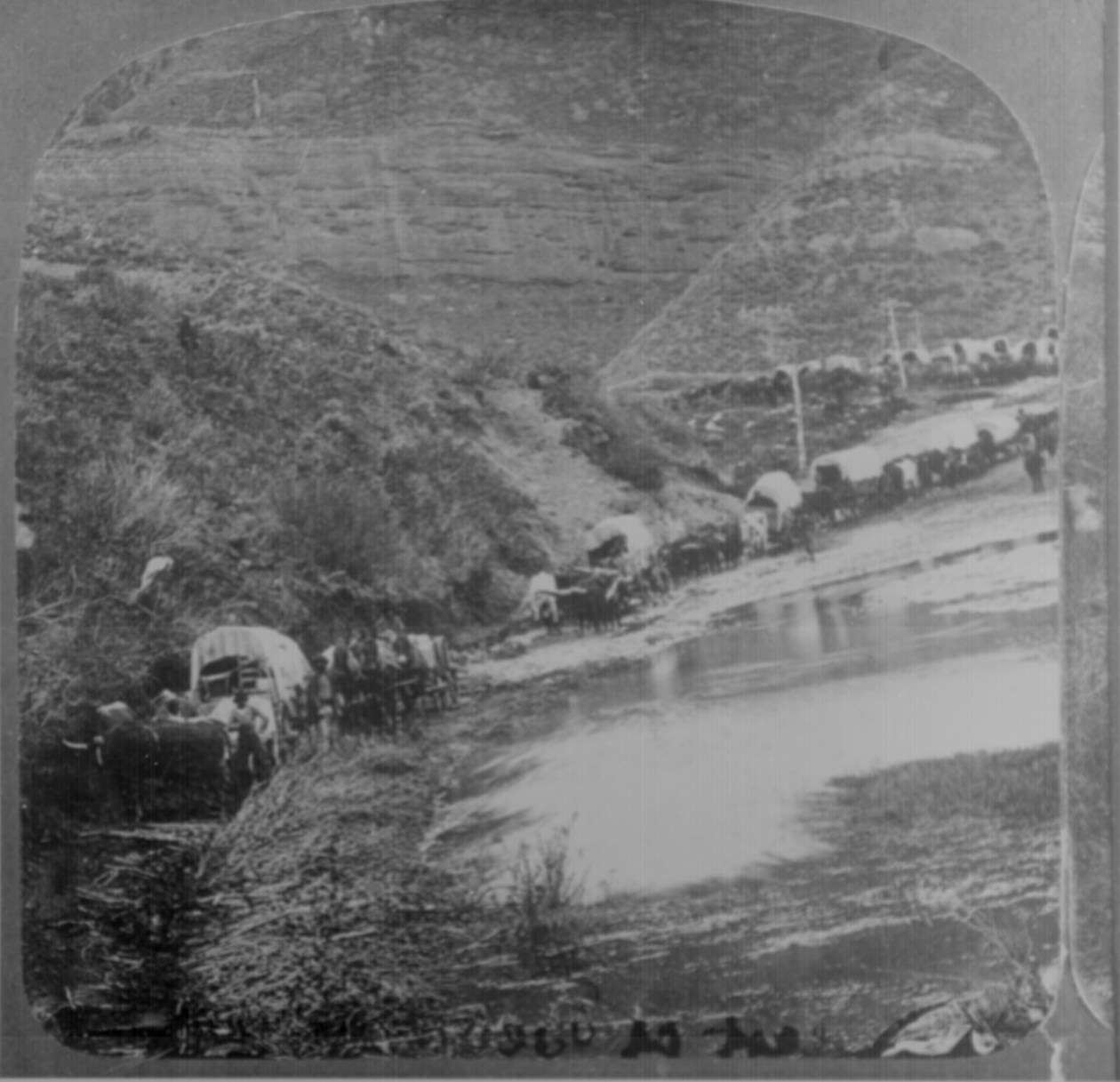
The William Henry Chipman Company consisted of 375 people—including the Abbotts and Mormon historian B. H. Roberts9—and about 60 wagons.  The Company departed Wyoming, Nebraska on July 11, 1866.10
  
Mormon wagon train circa 1879. 11

Most of the westward journey was typical: a few births and deaths, food made mostly of flour, cold weather and a great deal of walking. However, on August 14th, at Fort Laramie, Wyoming, soldiers stopped the wagon train and related that 100 people had recently been robbed and killed by Indians. And on the 18th “we had trouble with the Indians. We suppose they followed us. We had just corralled, and began to cook our dinners, when the alarm came that the Indians were driving away our cattle. They (the boys) followed them. They got away with ninety-one head and wounded three” oxen. On August 20th the Company “passed Deer Creek. The same day the Indians took our cattle, they took all the possessions of two homes, killed the people and burned their homes”.12 The Indians also burned down Deer Creek Station, a telegraph station and former Pony Express stop.13

Deer Creek Station before its destruction by fire. 14

The company continued on without further incident and “arrived in good condition on the 15th [of September], having made very good time”.15

Charlotte and William settled in Salt Lake City. They were sealed (married for eternity) in the Endowment House on February 23, 1869, obtaining through faith the temple ordinances for which they had trekked 6500 miles16, forsaken home and country, and left family, because they “judged him faithful who had promised”17.


_____________________________________________________________


Sources:

1 - All genealogical information (birth dates and places, baptism and sealing dates, etc.) is from familysearch.org. Charlotte's Person ID is KWJ8-TC2

2 - Photo from "Utah, Pioneers and Prominent Men of Utah, 1847-1868," index and images, FamilySearch(https://familysearch.org/pal:/MM9.1.1/KL71-4KQ : accessed 29 Nov 2014), William Abbott, ; excerpted from Frank Esshom, Pioneers and Prominent Men of Utah: Comprising Photographs, Genealogies, Biographies (Salt Lake City, Utah: Utah Pioneers Books, 1913).

3 - Encyclopedia of Mormonism, eom.byu.edu/index.php/Immigration_and_Emigration

4 - Encyclopedia of Mormonism, eom.byu.edu/index.php/Gathering

5 - Mark 10:29-30

6 - see James 2:18

7 - Quotes and information in this paragraph from Mormon Migration, 

London to New York

5 May 1866 - 11 Jun 1866

http://mormonmigration.lib.byu.edu/Search/showDetails/db:MM_MII/t:account/id:198/keywords:charlotte+abbott

8 - Passenger list from Mormon Migration website, http://files.lib.byu.edu/mormonmigration/registry%20images/MM_MII/Boxes%204-5/Images/CR%20271%2025_Bx%205%20Vol%201_00247.jpg

9 - from 

"Passenger List," Deseret News[Weekly], 26 Sep. 1866, 341

http://history.lds.org/overlandtravels/trailExcerptMulti?lang=eng&pioneerId=35112&sourceId=10503

10 - William Henry Chipman Company, Company Detail, http://history.lds.org/overlandtravels/companyDetail?lang=eng&companyId=87

11 - Photo, "Mormon emigrants." Photograph of covered wagon caravan by C. W. Carter ca. 1879. 165-XS-7 , from 
http://www.archives.gov/research/american-west/images/023.jpg

12 - Quotes and information in this paragraph from 

Clark, Caroline Hopkins, Diary, in Utah State Historical Society Cache Valley Chapter, Historical resource materials for Cache Valley, Utah-Idaho, 1955-1956, reel 1, item 10.

http://history.lds.org/overlandtravels/trailExcerptMulti?lang=eng&companyId=87&sourceId=4951

13 - This is presented on many sites, including 
http://www.blm.gov/wy/st/en/programs/nlcs/Historic_Trails/trails_tour.html#deer
http://www.legendsofamerica.com/wy-indianbattles2.html
http://wiki.wyomingplaces.org/w/page/25007519/Deer%20Creek%20Station
http://www.wyomingtalesandtrails.com/grock.html

14 - Drawing of Deer Creek Station by a soldier, University of Wyoming, American Heritage Center, Grace Raymond Hebard Papers, from 
http://wiki.wyomingplaces.org/w/page/25007519/Deer%20Creek%20Station

15 - from 

"Cap. W. Chipman's Train," Deseret News [Weekly], 19 Sep. 1866, 333.

http://history.lds.org/overlandtravels/trailExcerptMulti?lang=eng&companyId=87&sourceId=10804

16 - from Distance Table on Monday June 18 in 

The Diary of William Driver

http://mormonmigration.lib.byu.edu/Search/showDetails/db:MM_MII/t:account/id:200/keywords:charlotte+abbott

17 - Hebrews 11:11


_____________________________________________________________

Line of descent: 

Charlotte Freer Allibone, 1808-1879
Mary Ann Elizabeth Abbott, 1845-1920
George Cheshire, 1873-1935
Clara Lavon Cheshire, 1915-2007


Monday, November 4, 2013

(SMITH) Roger Williams, father of religious liberty

Roger Williams was born near London into a middle-class family in the early 17th century. He was formally educated and excelled in many subjects, including languages. Before leaving England, he was fluent in Latin, Greek, Hebrew, Dutch, and French1. He later learned several Native American languages.

Roger Williams thought it prudent to leave England because of his religious beliefs, and he arrived in Boston in 1631. He refused a position in the Boston church because it had not separated from the Church of England. He taught briefly in Salem, then made his way to Plymouth2. His "strange opinions,"3--such as, no kings, merely because they were Christian, had the right to "take and give away the Lands and Countries of other men," ie: Natives--made him unpopular with the Plymouth leadership, and after 2 years he returned to Salem. 

The rulers of Salem were more moderate, but Roger's ideas also got him in trouble there. In October 1635, Roger Williams was charged with "new and dangerous opinions," including "That we have not our Land by Patent from the King, but that the Natives are the true owners of it" and "That the Civil Magistrates power extends only to the...outward state of men"4. In other words, Roger Williams believed that Indians should be paid for their land, and that individuals should have the right to worship according to the dictates of their own conscience, for "God requireth not a uniformity of religion to be enacted and enforced in any civil state; which enforced uniformity (sooner or later) is the greatest occasion of civil war, ravishing of conscience, persecution of Christ Jesus in his servants, and of the hypocrisy and destruction of millions of souls."5 For this, the Massachusetts court decided, "Whereas Mr. Roger Williams, one of the elders of the church of Salem, hath broached & divulged diverse new & dangerous opinions... it is therefore ordered, that the said Mr. Williams shall depart out of this jurisdiction within six weeks."4

Meanwhile, Roger Williams continued sharing these radical ideas, and the court decided to deport him to England immediately. He was warned, however, by a good friend, former governor John Winthrop, and fled Salem a few days before the sheriff arrived to arrest him.6

"The winter of 1635/6 was cold even by New England standards. That winter, Narragansett Bay froze over, an event that rarely happens. In this extreme cold, Roger Williams, a city boy from London, made his escape on foot from Salem."4 Of this event, Williams later wrote: "I was unmercifully driven from my chamber to a winter's flight, exposed to the miseries, poverties, necessities, wants, debts, hardships, of sea and land, in a banished condition. For...fourteen weeks, in a bitter winter season, I was sorely tossed and knew not what bread or bed did mean."6

Williams headed south, walking over 100 miles through deep snow. Eventually, he was given shelter among a Wampanoag tribe. After a few months, Williams negotiated with the Natives for his own land on Narragansett Bay. Then, "having made covenant of peaceable neighborhood with all the sachems [chiefs] and natives round about us, and having, in a sense of God’s merciful providence unto me in my distress, called the place PROVIDENCE, I desired it might be for a shelter for persons distressed for conscience."4


Me at Roger Williams National Memorial in Providence, Oct. 2012.
This park marks the site where Roger Williams built his home.
Roger Williams firmly believed in "soul liberty"--that all people should be allowed freedom of conscience, provided such an exercise did not harm others. He said of his settlement, "The Most High and only Wise hath provided this country and this corner as a shelter for the poor and persecuted according to their several persuasions."4 Rhode Island quickly became a haven for those of different beliefs, including Quakers and Antinomians. The state boasts the first Baptist church in America and the oldest synagogue on the continent7, both of which were built during Williams' lifetime.


The First Baptist Church in America, founded by Roger Williams in 1638,
though he eventually left organized religion. This building was erected in 1775.
Photo taken October 2012.
That his colony might be legally recognized by the English government, Williams traveled to London. He obtained a charter with two amazing provisions. First, "that it shall not bee lawfull to or for the rest of the Collonies to invade or molest the native Indians, or any other inhabittants, inhabiting within" the colony's bounds, they "being by us taken into our speciall protection." And more incredibly, considering that English citizens in England were not given this privilege, granting a "lively experiment...that all and every person and persons may...at all times hereafter, freely and fully have and enjoy his and their own judgments and consciences, in matters of religious concernments."4

Roger Williams is credited with the beginning of separation of church and state in the New World. Although deeply religious, he believed the government should not interfere in a person's relationship with God; government should only be concerned with community relations.

Roger was born into the Church of England, became a Puritan minister, and spent a few years as a Baptist. But "his search for the true church eventually carried him out of ... any visible church," although he continued to actively preach. "From 1639 forward, he waited for Christ to send a new apostle to reestablish the church, and he saw himself as a 'witness' to Christianity until that time came."8

Williams was convinced that authority to perform ordinances was lost in the Apostasy, and "could not be validly restored without a special divine commission."8 He declared: There is "no regularly-constituted church on earth, nor any person authorized to administer any Church ordinance; nor could there be until new apostles were sent by the great Head of the Church for whose coming he was seeking."9

Williams had several other beliefs that separated him from the churches of the time. He was opposed to infant baptism, as infants could not understand and accept the ordinance. 

He "did not believe in taking money for being a preacher. He earned his living by farming and trading blankets and knives with the Indians.”1 He wrote of ministers, "in their wages...they have always run in the way of a hire, and rendered such workmen absolute hirelings between whom and the true Shepherd, the Lord Jesus (John 10), puts so express and sharp a difference. [In John 10, the Lord declares that the true shepherd gives his life for the sheep, but the hireling sees the wolf coming and flees, caring not for the sheep.]...I am bold to maintain that it is one of [the] grand designs of the Most High to break down the Hireling Ministry, that trade, faculty, calling, and living by preaching."10

His ideas on freedom of conscience continued to differ sharply from the mainstream. In 1644, Williams was in London to secure a charter for his colony. While there, he wrote the book A Bloudy Tenant, "one of the most comprehensive treatises about the freedom of religion ever written,"11 which contained the revolutionary idea that governmental authority was granted by the people, not by God. Parliament, outraged, ordered that all copies of the book be burned. I'd say it's a pretty successful revolutionary who inspires a book burning. :)

Furthermore, Williams opposed slavery. In 1652, his settlement passed a law prohibiting it. Unfortunately, when other settlements were joined together to make the colony of Rhode Island, some areas refused to accept the law and it was disregarded.8

This great man consistently lived according to his conscience, whatever the consequences. He was courageous, charismatic, and an exceptionally good human being. Even his enemies agreed on that.

Thus was the life of Roger Williams, the founder of the state officially named "State of Rhode Island and Providence Plantations." 


_____________________________________________________________________________
***I did NOT research the genealogy for this post. I researched Roger Williams thoroughly and have cited sources below. However, I am depending on someone else's genealogic accuracy; I have NOT verified this line of descent. That being said, here is the genealogy, according to contributors on familysearch.org:

Alice Zemp, born 1925
Lucia Scoville, born 1889
Maria Holt, born 1861
Sarah Carr, born 1838
Thomas Carr, born 1791
Benjamin Carr, born 1762
Benjamin Carr, born 1725
Caleb Carr, born 1700
Deborah Sayles, born 1656
Mary Williams, born 1620
Roger Williams, born about 1603


1 - PBS biography of Roger Williams, http://www.pbs.org/wnet/historyofus/web03/features/bio/B05.html
2 - Roger Williams, by Henry Chupack, 1969
- History of the Pilgrims and Puritans, Joseph Dillaway Sawyer, 1922 http://books.google.com/books?id=HK4TAAAAYAAJ&dq=history+of+the+pilgrims+and+puritans&source=gbs_navlinks_s
- NPS biography of Roger Williams: http://www.nps.gov/rowi/historyculture/rogerslife.htm and ensuing pages
- Roger Williams, A Plea for Religious Liberty, http://www.constitution.org/bcp/religlib.htm
- Voices from Colonial America: Rhode Island, 1636-1776, by Jesse McDermott
- The Thirteen Colonies: Rhode Island, by Craig & Katherine Doherty
- Picturesque America, ed. William C. Bryant, 1872, p. 496-502
http://books.google.com/books?id=HwRUAAAAcAAJ&printsec=frontcover&dq=picturesque+america&hl=en&sa=X&ei=Xvl2UsGiOc_EiwLB24GgBw&ved=0CDUQ6AEwAQ#v=onepage&q=picturesque%20america&f=false
10 - Roger Williams, "The Hireling Ministry," in On Religious Liberty: Selections from the Works of Roger Williams, by Roger Davis, http://books.google.com/books?id=DUn2VWvZG0sC&printsec=frontcover#v=onepage&q&f=false
11 - Smithsonian Mag: http://www.smithsonianmag.com/history-archaeology/God-Government-and-Roger-Williams-Big-Idea.html?c=y&story=fullstory [I strongly recommend this one for further reading! It's an excellent article.]