Tuesday, December 23, 2014

(LUKE) Zenda the Riveter

Zenda Lang, circa 1942
Zenda Lang reached adulthood shortly after the United States entered World War II.

Zenda “went to work at Lockheed for a while. They taught me how to rivet”—but then, learning that Zenda had epilepsy—“they put me in an office. They taught me how, and then they wouldn't let me do it. They found out about my medical history. They figured that something might happen and I might put in a claim."

After working for Lockheed for about a year and a half, Zenda moved on. She was wiser this time: “So the next place I went as long as I knew how to rivet I just didn't bother to tell them about the rest of it and got along just fine.” For the rest of the war, Zenda was a riveter.

Zenda helped make the P-61 Black Widow. German bombers were more likely to attack under cover of night. The P-61 was the first US night fighter and the first aircraft designed to use radar. With its radar, the P-61 could track and destroy enemy aircraft in complete darkness. 

Northrop P-61 Black Widow
Zenda described her work on the Black Widow: “We put an auxiliary tank on it. Northrop had built it and then this small company in Van Nuys was doing auxiliary work. Put an extra tank on it. I was out on the line, I was the only lady out there, but those men were terrible, a couple of them. Know how to do mechanics, these guys didn’t. Every now and then the boss would yell, ‘Lang, come here and see if you can fix this hole.’ And I’d go over and see if I could plug it up for him.”

Zenda's experience was not unique. Other riveters commented that the men, confident that they could do “men's work,” were less careful and made mistakes more frequently. Furthermore, rivets were often needed in small spaces—spaces that more easily accommodated small females.

Despite the women's skill, the jobs did not last. Zenda relates, “When the war ended in ’45 I was working at Northrop and everybody just laid down their tools and walked away. I mean they all knew that that was the end of the job, except for a few. There was no sense hanging around.” When asked what she did at the end of the war, Zenda replied, “Put my tools down and walked away. When I tried to get another job as a riveter they had their men that had been in the armed services that the jobs were promised to. I mean Congress had passed a law that said they had first choice. So anyway, this cut out quite a few. They said, We don’t care if you did do riveting; these guys have done it much longer, so we’ll keep them.”

As she still required an income, Zenda became a file clerk and later a proofreader. After marrying, she stayed home to raise her children.

Reflecting on her work as a riveter, Zenda said, “I think sometimes women can do things just as well as men. I figure they should be in the home, if they are able to, but it’s nice to know you can do other things too.”


___________________________________
Notes:

Zenda's quotations are all from an interview conducted by Jerry and Carol Roberts on September 6, 1981.

Information on the P-61 is from the following websites:
· “Nothrop P-61 Black Widow,”  www.world-war-2-planes.com/northrop-p-61-black-widow.html  , Accessed 23 December 2014. 
· “Northrop P-61 Black Widow Night Fighter,” worldwar2headquarters.com/HTML/aircraft/americanAircraft/p61.html , Accessed 23 December 2014. 
· “Northrop P-61C Black Widow,” National Museum of the US Air Force,  www.nationalmuseum.af.mil/factsheets/factsheet.asp?id=524  , Accessed 23 December 2014. 
· “Northrop P-61 Black Widow,” wikipedia, en.m.wikipedia/wiki/Northrop_P-61_Black_Widow , Accessed 23 December 2014.

Poster is from UNT Digital Library. United States. War Manpower Commission. Women in the war : we can't win without them.  http://digital.library.unt.edu/ark:/67531/metadc616/  . Accessed 23 December 2014.

Black Widow picture is from wikimedia, P-61 Black Widow category

Saturday, November 29, 2014

(SCOFIELD) Charlotte Abbott and the Indian Raid

Charlotte Freer Allibone, the third of Joseph Allibone and Elizabeth Freear’s nine children, was born January 6, 1808 in Irchester, Northamptonshire, England.1 

Shortly before her 21st birthday, Charlotte married William Abbott.2 He and their ten children were also born in Northamptonshire. Chances were fair that Charlotte, like her parents before her, would spend her entire life within the bounds of one English county.

But faith intervened.

Charlotte and William were baptized into The Church of Jesus Christ of Latter-day Saints in June 1850. Several of their children also joined the Church in the ensuing years. Brigham Young, the president of the church, once taught that emigration, “upon the first feasible opportunity, directly follows obedience to the first principles of the gospel”.3 Joseph Smith taught that the faithful immigrated, or “gathered,” to Zion “to build unto the Lord an house whereby he could reveal unto his people [temple] ordinances”.4 All faithful Latter-day Saints had a desire to receive temple ordinances. In Charlotte and William’s time, temple ordinances were available in one place: Utah.

During his mortal ministry the Savior taught, “There is no man that hath left house, or…children, or lands, for my sake, and the gospel’s, But he shall receive an hundredfold now in this time…and in the world to come eternal life”.5 Charlotte and William showed their faith in Him by their works:6 in 1866 they departed for Utah, along with their daughter Mary Ann Elizabeth Abbott George (later Cheshire) and her son William. They sailed from London on May 5, 1866 aboard the Caroline. Of this voyage a contemporary newspaper noted, “the vessel itself being 8½ feet between decks, and possessing many other conveniences and comforts….But… of far greater importance…the people were inspired with the spirit of confidence in their God. One and all looked on the trials and dangers of a sea voyage with unflinching courage, having an assurance that God was their friend…". After five weeks at sea, they “arrived at New York June 11th, and…continued the journey by steamboats and railroad” and wagon train.7 


Passenger list. Charlotte's family are the last 4 on the page. 8
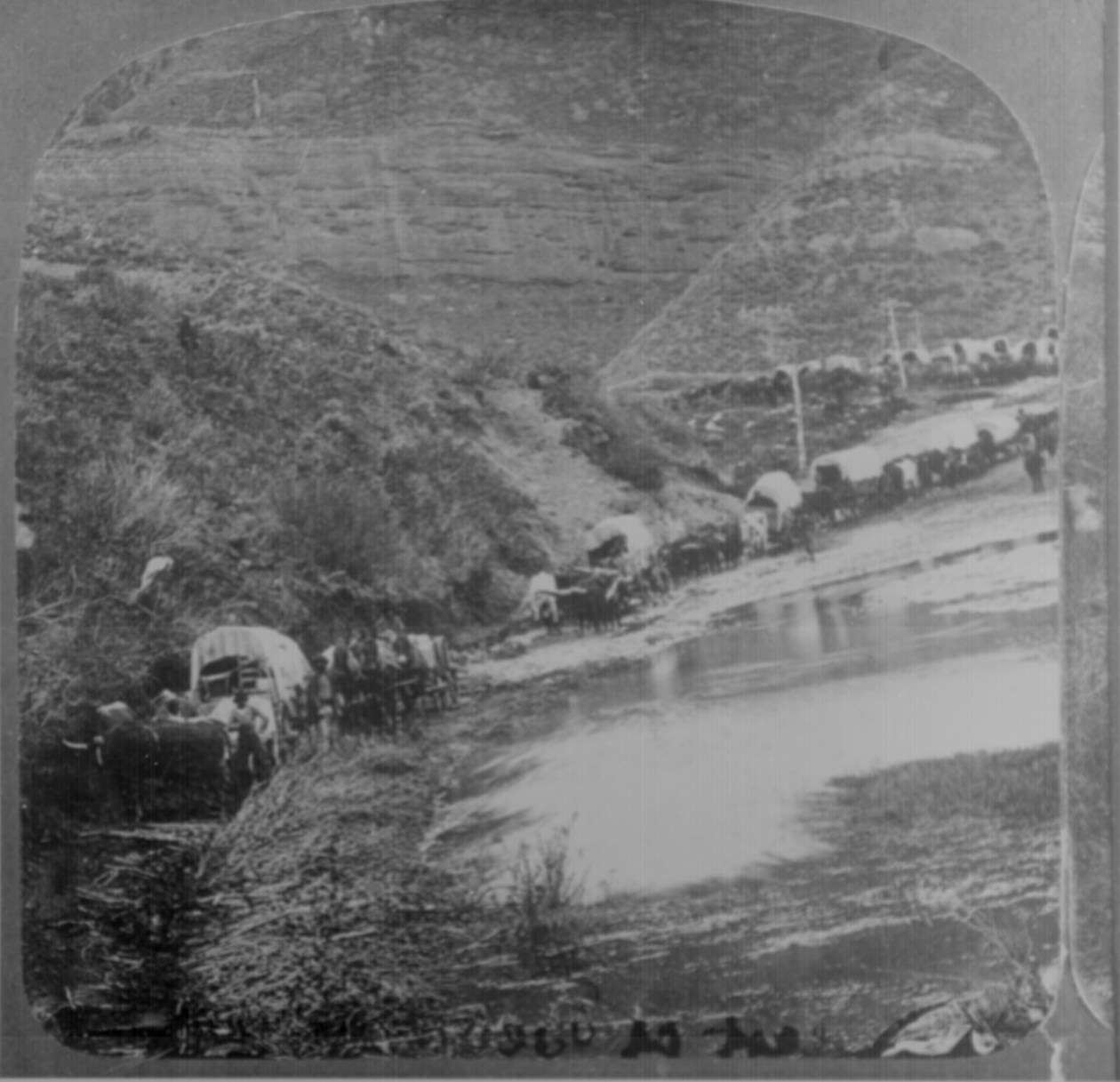
The William Henry Chipman Company consisted of 375 people—including the Abbotts and Mormon historian B. H. Roberts9—and about 60 wagons.  The Company departed Wyoming, Nebraska on July 11, 1866.10
  
Mormon wagon train circa 1879. 11

Most of the westward journey was typical: a few births and deaths, food made mostly of flour, cold weather and a great deal of walking. However, on August 14th, at Fort Laramie, Wyoming, soldiers stopped the wagon train and related that 100 people had recently been robbed and killed by Indians. And on the 18th “we had trouble with the Indians. We suppose they followed us. We had just corralled, and began to cook our dinners, when the alarm came that the Indians were driving away our cattle. They (the boys) followed them. They got away with ninety-one head and wounded three” oxen. On August 20th the Company “passed Deer Creek. The same day the Indians took our cattle, they took all the possessions of two homes, killed the people and burned their homes”.12 The Indians also burned down Deer Creek Station, a telegraph station and former Pony Express stop.13

Deer Creek Station before its destruction by fire. 14

The company continued on without further incident and “arrived in good condition on the 15th [of September], having made very good time”.15

Charlotte and William settled in Salt Lake City. They were sealed (married for eternity) in the Endowment House on February 23, 1869, obtaining through faith the temple ordinances for which they had trekked 6500 miles16, forsaken home and country, and left family, because they “judged him faithful who had promised”17.


_____________________________________________________________


Sources:

1 - All genealogical information (birth dates and places, baptism and sealing dates, etc.) is from familysearch.org. Charlotte's Person ID is KWJ8-TC2

2 - Photo from "Utah, Pioneers and Prominent Men of Utah, 1847-1868," index and images, FamilySearch(https://familysearch.org/pal:/MM9.1.1/KL71-4KQ : accessed 29 Nov 2014), William Abbott, ; excerpted from Frank Esshom, Pioneers and Prominent Men of Utah: Comprising Photographs, Genealogies, Biographies (Salt Lake City, Utah: Utah Pioneers Books, 1913).

3 - Encyclopedia of Mormonism, eom.byu.edu/index.php/Immigration_and_Emigration

4 - Encyclopedia of Mormonism, eom.byu.edu/index.php/Gathering

5 - Mark 10:29-30

6 - see James 2:18

7 - Quotes and information in this paragraph from Mormon Migration, 

London to New York

5 May 1866 - 11 Jun 1866

http://mormonmigration.lib.byu.edu/Search/showDetails/db:MM_MII/t:account/id:198/keywords:charlotte+abbott

8 - Passenger list from Mormon Migration website, http://files.lib.byu.edu/mormonmigration/registry%20images/MM_MII/Boxes%204-5/Images/CR%20271%2025_Bx%205%20Vol%201_00247.jpg

9 - from 

"Passenger List," Deseret News[Weekly], 26 Sep. 1866, 341

http://history.lds.org/overlandtravels/trailExcerptMulti?lang=eng&pioneerId=35112&sourceId=10503

10 - William Henry Chipman Company, Company Detail, http://history.lds.org/overlandtravels/companyDetail?lang=eng&companyId=87

11 - Photo, "Mormon emigrants." Photograph of covered wagon caravan by C. W. Carter ca. 1879. 165-XS-7 , from 
http://www.archives.gov/research/american-west/images/023.jpg

12 - Quotes and information in this paragraph from 

Clark, Caroline Hopkins, Diary, in Utah State Historical Society Cache Valley Chapter, Historical resource materials for Cache Valley, Utah-Idaho, 1955-1956, reel 1, item 10.

http://history.lds.org/overlandtravels/trailExcerptMulti?lang=eng&companyId=87&sourceId=4951

13 - This is presented on many sites, including 
http://www.blm.gov/wy/st/en/programs/nlcs/Historic_Trails/trails_tour.html#deer
http://www.legendsofamerica.com/wy-indianbattles2.html
http://wiki.wyomingplaces.org/w/page/25007519/Deer%20Creek%20Station
http://www.wyomingtalesandtrails.com/grock.html

14 - Drawing of Deer Creek Station by a soldier, University of Wyoming, American Heritage Center, Grace Raymond Hebard Papers, from 
http://wiki.wyomingplaces.org/w/page/25007519/Deer%20Creek%20Station

15 - from 

"Cap. W. Chipman's Train," Deseret News [Weekly], 19 Sep. 1866, 333.

http://history.lds.org/overlandtravels/trailExcerptMulti?lang=eng&companyId=87&sourceId=10804

16 - from Distance Table on Monday June 18 in 

The Diary of William Driver

http://mormonmigration.lib.byu.edu/Search/showDetails/db:MM_MII/t:account/id:200/keywords:charlotte+abbott

17 - Hebrews 11:11


_____________________________________________________________

Line of descent: 

Charlotte Freer Allibone, 1808-1879
Mary Ann Elizabeth Abbott, 1845-1920
George Cheshire, 1873-1935
Clara Lavon Cheshire, 1915-2007


Thursday, November 20, 2014

(ROBERTS) James Robert Laws

{This is one of four posts about my children's ancestors named James--one James from each grandparent's ancestral line.}


James Robert Laws was born July 12, 1868 in Joliet, Illinois to James Laws and Mary Ann Lowe. In the 1870s, James's family moved to Kansas. 


Location of Kansas in the United States, from wikipedia 

James married Sarah Elizabeth White on November 2, 1887. 


Sarah Elizabeth White Laws in her later years

They had 9 children. 


7 of the 9 Laws children
Kline, Eva, Silas, Nina, Homer, Anna, Charles
Not pictured: Maude, Curtis

James settled his family in Coffey County. 


Location of Coffey County in Kansas, from wikipedia 

Around 1900, he purchased land in Pleasant Township, an area of 68 square miles, populated, in 1900, by 1200 people. (The population has since consistently declined; it is now about 250.) 


Location of Pleasant Township in Coffey County,
from kansasmemory.org 

James appears to have owned 80 acres, located in Township 21 S, Range 14 E, Section 7. 


Location of Section 7 in 1901 plat map. James's
land is in the center labeled J R Laws
from kansasmemory.org

Location of Section 7 in 1919 plat map. James's
land is in the center labeled J R Laws
from kansasmemory.org 

James continued on this farm until his death in September 1945. 


James's death certificate 

James's obituary
from the Emporia Gazette, Sep 10, 1945


_______________________________________________________________

Line of descent:
James Robert Laws, born 1868
Eva Irene Laws, born 1892
Dolores Mae Peters, born 1927


_______________________________________________________________

Sources:

1 -http://en.m.wikipedia.org/wiki/Pleasant_Township,_Coffey_County,_Kansas
2 -http://en.m.wikipedia.org/wiki/Coffey_County,_Kansas
3 -http://www.kansasmemory.org/item/209376/page/16
4 -http://www.kansasmemory.org/item/223987/page/23

Wednesday, November 12, 2014

(SMITH) James Greaves

{This is one of four posts about my children's ancestors named James--one James from each grandparent's ancestral line.}
_______________________________________________________________

James Greaves was born in 1773 in Shaw, Lancashire, England. He married Betty Buckley; they had two daughters. 


James's life spanned a time of local transition. Shaw had previously been so small that "going to Shaw was synonymous with going to church as there was not much else there." At that time "the area was sparsely populated and consisted of woods, moors and bogs." Shaw, with poor soil and rugged terrain better suited to sheep grazing than farming, had long been dependent on woolen manufacture.  Though wool was the foundation of the local economy, international demand was growing for a different clothing fiber: cotton. 


As it turned out, Shaw's damp climate was ideal for spinning cotton; it kept the cotton threads from drying and breaking. When James was 10, a cotton mill was built in the area. When James was 20, there were a dozen mills and Shaw's population had at least doubled. 


As is often the case, change was not completely welcome. To encourage and support wool production during the transition decades, there was a law in Shaw that the bodies of the deceased had to be dressed in woolen clothing. Nevertheless, the area became increasingly dedicated to industrialized cotton spinning and textile manufacture. 


James's grandchildren were born during a time of conflict as hand loom weavers faced the reality that they could not work as fast as machines. There was even a local riot during which many power looms were smashed. Despite the violence, progress and mechanization marched on, and Shaw was solidly a mill town for the next 150 years. 


_______________________________________________________________

Line of descent:


James Greaves, born 1773

Ann Greaves, born 1799
Alice Greaves Hurst, born 1819
Asa Brigham Scoville, born 1861
Lucia Naomi Scoville, born 1889
Alice Zemp, born 1925


_______________________________________________________________

Sources: 


1 -  www.lan-opc.org.uk/Oldham/Shaw-and-Crompton  The quotes are from this website. 

2 - www.genuki.org.uk/big/eng/LAN/Shaw/#Description 
3 - en.m.Wikipedia.org/wiki/Shaw_and_Crompton
4 - www.familysearch.org person ID LZFD-7P8
big/eng/LAN/Shaw/#Description-http://e

Thursday, November 6, 2014

(LUKE) James Kirkman

{This is one of four posts about my children's ancestors named James--one James from each grandparent's ancestral line.}
_______________________________________________________________

James Kirkman was born October 8, 1823 at Breightmet Fold, Lancashire, England, the son of John Kirkman and Ellen Lomax. His baptism into the Church of Jesus Christ of Latter-day Saints on November 21, 1843 makes him our children's only "James" ancestor who was also Mormon. He attended the Bolton, Manchester, England Conference and was branch president for years. 

James married Mary Haslam on October 29, 1843 in Middleton Parish, Ainsworth, Lancashire, England. They had 12 children. The Kirkmans lived in a rowhouse in the village of Darcy Lever, near Bolton. According to James's granddaughter, peace, joy, and love abounded in his home. Their family were the only Mormons in the village of about 1,000 people. 

James was a miner--presumably a coal miner. His children worked in a nearby mill (almost certainly a cotton mill) from an early age. James died on February 27, 1874 at Darcy Lever, Lancashire, England. Many of his children later emigrated to the United States. 

_______________________________________________________________

Line of descent:

James Kirkman, born 1823
Ann Kirkman, born 1850
Sarah Jane Howarth, born 1882
Russell Victor Luke, born 1905

_______________________________________________________________

Sources:
- ancestry.com, Membership of the Church of Jesus Christ of Latter-day Saints, 1830-1848
- "Utah Pioneer Ann Kirkman," www.oocities.org/iluv_familyhistory/annkhowarth.htm
-Darcy Lever population from www.mancuniensis.info/DarcyLeverFP.htm

Monday, October 6, 2014

(SCOFIELD) James Clayton

{This is one of four posts about my children's ancestors named James--one James from each grandparent's ancestral line.}
_______________________________________________________________


According to familysearch.org, James Clayton was born around 1780. In 1798, he married Elizabeth Price. Their 8 children were born in North Carolina in the early 1800s.

At that time, North Carolina was sparsely populated. The State consisted principally of farms and very small towns. The majority of North Carolinians, probably including the Claytons, were not slaveholders. There was little industry—raw goods were typically processed out of state. There were no public schools.1 

The State lacked good roads, many farmers used outdated practices, and poverty and ignorance flourished.2 

North Carolina made so little progress during this era that it became known as the “Rip Van Winkle State.”3

During the first half of the 19th Century, many people emigrated from North Carolina “due to a struggling economy, indifference to education, resistance to taxation for any reason, and general backwardness.”4 “In 1834 a Raleigh newspaper reported that 'our roads are thronged with emigrants to a more favored Country.'”5  

Despite all this, the James Clayton family remained. James's descendants lived in the State for several generations, and his posterity, including his 6th great grandson, are thriving today.
_______________________________________________________________


Line of descent:
James Clayton, born 1780
Deborah Clayton, born 1803
Susan Myrick, born 1826
Mary Elizabeth Shearin, born 1851
Claudia Helen Reid, born 1889
Clara Lavon Cheshire, born 1915


_______________________________________________________________

Sources:
1 - aam.wcu.edu/projects/farrands/history1800s.htm
2 - www.learnnc.org/lp/editions/nchist-newnation/4389
3 - www.secretary.state.nc.us/kidspg/history.htm 
4 - www.carolana.com/NC/1800s/nc_1800s_overview.html
5 - www.learnnc.org/lp/editions/nchist-newnation/4389

Sunday, July 13, 2014

(ROBERTS) Jerry and the Rhubarb

One night in the 1950s, or thereabouts, little Jerry Roberts was walking home. 

El Monte area, California

His family lived on Fawcett Ave in South El Monte, California. Although the area is now urban, at the time it was surrounded by fields and a hog farm called Durfee's Ranch.


South El Monte, showing Legg Lake and Fawcett Ave (the red marker)
Notice also Durfee Ave, named after the ranch that used to be in the area
As Jerry walked home, he noticed the fields of rhubarb near Legg Lake. He happened to have a grocery bag with him, and he happened to like rhubarb, so he started to pick some.

Next thing he knew, a cop was pulling over. 

"What are you doing?" the officer asked. 

"I'm just picking some rhubarb," Jerry replied. 

"You can't do that," he was told.

Reminiscing on the story 50 years later, he added, "I don't think I even got to pick any" before the cop arrived.


The family larder was not filled that night, but a simple story was created that has become a beloved part of my family's lore.


Little Jerry Roberts :)
Don, Jack, Jerry, and Diana Roberts at their Uncle Curtis Laws' house,
circa 1954